


Independent pharmacies dispensing Schedule II controlled substances face a recordkeeping burden that most pharmacy management software was never designed to solve. DEA-compliant controlled substance logs require precision, accountability, and an audit trail that can hold up under inspection. For years, the standard approach at independent pharmacies was a paper log, a binder, and the hope that nothing went wrong.
I was one of those pharmacists. As a supervising pharmacist at an independent community pharmacy, I managed Schedule II controlled substance recordkeeping the way most independent pharmacies still do today: manually, on paper, one entry at a time. And for a long time, I assumed the problems that came with it were simply part of the job.
They are not. And that realization is what led me to build C2 Vault.
Pharmacies searching for a better way to manage controlled substance logs often rely on manual C2 log books or spreadsheets, both of which create risk during DEA audits. Modern controlled substance recordkeeping systems are designed to reduce that risk by maintaining accurate, traceable records in real time.
The real cost of paper-based controlled substance logs
Paper controlled substance logs (C2 log books) are not just inconvenient. They are a genuine compliance risk, and independent pharmacies carry that risk almost entirely on their own.
In my pharmacy, pages went missing. Not because of negligence, but because paper is fragile and a busy dispensing shift is not a controlled environment. A log sheet pulled during a count and not returned to the binder. A page misfiled. A spill. Any of these creates a gap in your controlled substance records, and a gap in your DEA records is not something you can explain away after the fact.
Then there was the handwriting. A quantity written under pressure that looked like a 3 or an 8 depending on who was reading it. A date that could have been the 6th or the 8th. These were not dispensing errors. They were documentation errors, and in a DEA audit, your documentation is your defense.
Every time I restocked the safe, I was not just counting pills. I was hoping the numbers balanced, because if they did not, tracing a discrepancy through pages of handwritten entries was hours of work with no guaranteed answer.
Inventory counts were the most stressful part. Restocking the Schedule II safe should be a routine task. Instead it carried a low-grade dread: hoping the running count matched the physical count, and knowing that if it did not, reconciling the discrepancy meant going back through handwritten entries line by line looking for where things diverged.
Why existing pharmacy software did not solve the problem
Independent pharmacies already use pharmacy management software for prescription processing, but most pharmacy management systems were not built to handle controlled substance recordkeeping the way the DEA actually requires it. Schedule II logs need to be maintained separately from other records. Every dispense needs to be tied to an individual staff member. The audit trail needs to be tamper-evident and immediately retrievable.
The software that existed was either a large integrated pharmacy management platform — too expensive and complex for a single independent pharmacy — or it was designed for hospital or institutional settings with entirely different workflows. Nothing was purpose-built for what a supervising pharmacist at an independent community pharmacy actually needs: a clean, affordable, DEA-compliant controlled substance log with user-level accountability and a real audit trail.
So pharmacies kept using paper. And the compliance risk kept sitting there, shift after shift.

The decision to build something different
There was no single moment that pushed me to build C2 Vault. What there was, was a specific afternoon where I opened the safe to restock, felt the familiar knot of dread settle in before I had even started counting, and decided I was done accepting it.
I thought about every other industry that handles regulated inventory at scale. Banks, hospitals, clinical research facilities. None of them manage compliance-critical records on paper binders. The tools exist to do this properly. Someone just needed to build the right one for independent pharmacy.
I brought in a co-founder who understood software and shared the conviction that independent pharmacies deserved a compliance tool built specifically for them. We designed C2 Vault around the actual problems I had experienced: lost pages, illegible entries, inventory discrepancies that were hard to trace, and the constant uncertainty of not knowing whether your controlled substance records would hold up under DEA scrutiny.
What C2 Vault is built to do
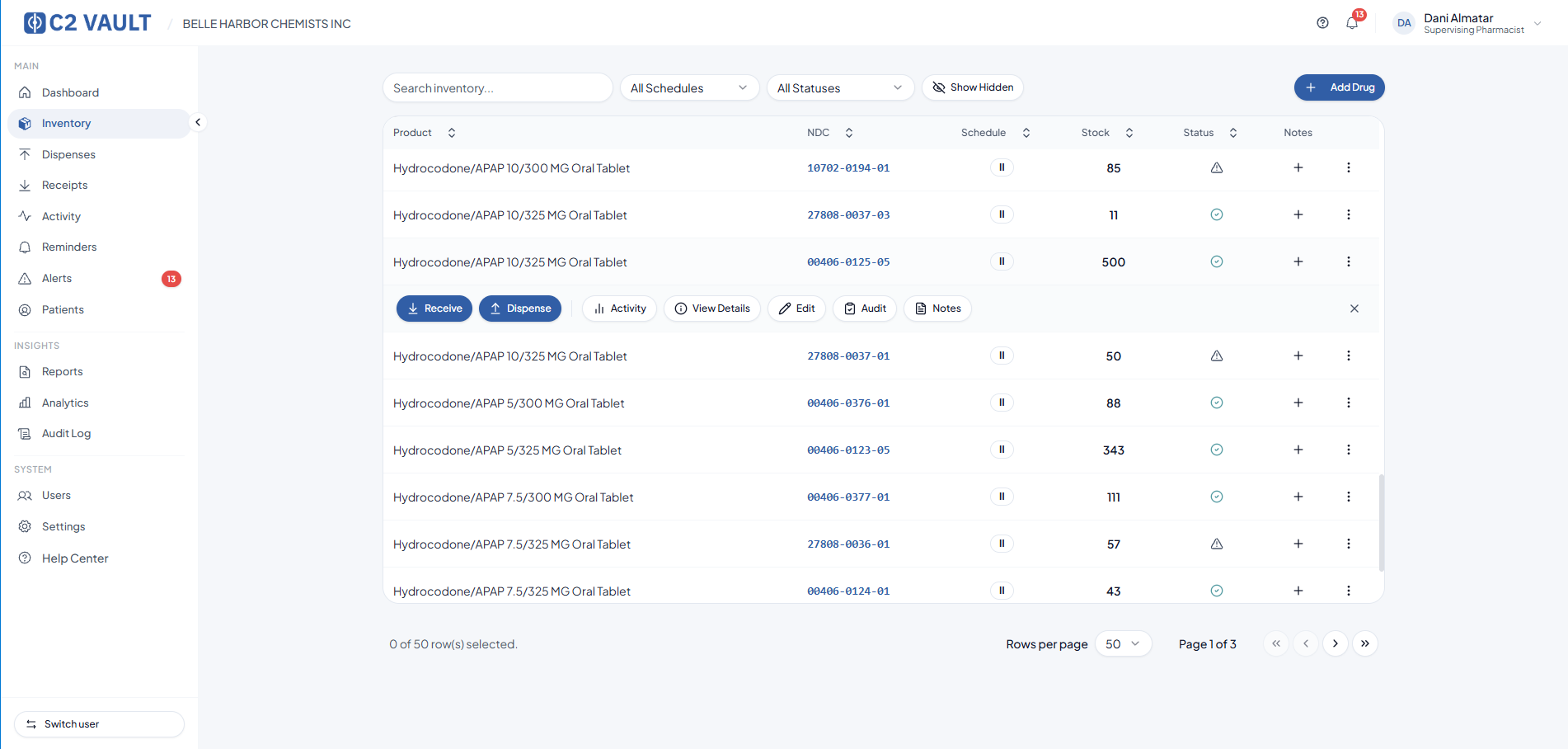
C2 Vault is controlled substance recordkeeping software built specifically for pharmacies. It logs every controlled substance receipt and dispense with user-level attribution, maintains a tamper-evident audit trail, and keeps controlled substance records in the separate, immediately retrievable format that DEA regulations require.
Every entry is tied to a specific staff member. Every transaction is timestamped. Nothing can be quietly changed after the fact. When an investigator asks to see your records, the answer is a few clicks, not an hour spent locating a binder and hoping the pages are all there.
We also kept C2 Vault focused. There are platforms that try to do everything. C2 Vault does one thing well: DEA-compliant controlled substance recordkeeping for independent pharmacies that cannot afford to get it wrong. That focus is deliberate. The problem is specific enough to deserve a specific solution, built by someone who lived with it.
For every pharmacist who recognized this problem
If you are a supervising pharmacist or pharmacist-in-charge at an independent community pharmacy, and you recognized any part of what I described, I built this for you. Not for a compliance department that has never worked a dispensing shift. For the pharmacist who is personally responsible for controlled substance recordkeeping and who knows exactly what it feels like when that responsibility does not come with tools equal to the task.
The dread of opening the safe does not have to be part of the job. It was never supposed to be.
This article is provided for general informational purposes only and does not constitute legal or regulatory advice. C2 Vault, LLC makes no representations that use of the Application alone ensures DEA or state compliance. Pharmacy registrants remain solely responsible for compliance with all applicable federal and state controlled substance regulations. Consult qualified legal counsel for advice specific to your operations.